Flamengo Fined by CONMEBOL Over Anti-Betting Ban Banner: What the $36,000 Penalty Means


CONMEBOL fined Flamengo $36,000 for four violations at the Maracanã match against Estudiantes, including $8,000 for a banner opposing Brazil's betting ban. This article breaks down the fine, how it will be collected, and why the case matters for betting operators and affiliates.
The 22 October match at Maracanã and the banner that triggered the fine
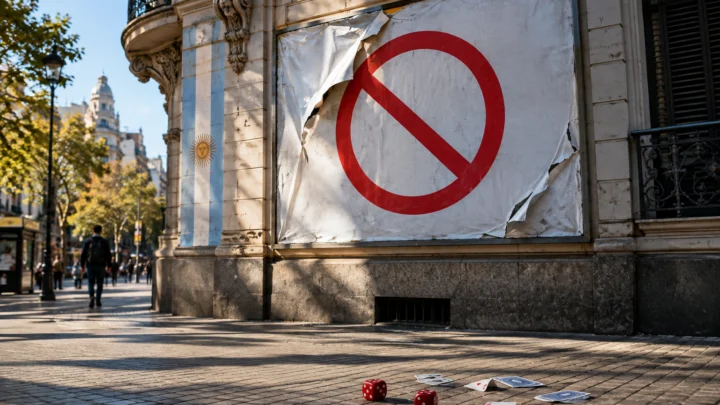
Flamengo played Estudiantes de La Plata at the Maracanã on 22 October. And during the match a banner reading "Proibir não é proteger" ("Banning is not protecting") was displayed in the stands. The message targeted Brazil's ban on online betting, a position the country's gambling operators have pushed hard in public. The banner had not been submitted to CONMEBOL for approval beforehand. That omission, rather than the message itself, is what the competition's rules address.
The CONMEBOL disciplinary decision that followed fines Flamengo $36,000 in total for four violations, with the unapproved banner among them. The sum covers all four items, so it is not the penalty for the banner alone. The decision treats the display as a breach of competition rules, not as a ruling on Brazilian gambling law.
Four violations behind the $36,000 total
The $36,000 total comes from four violations recorded against Flamengo for the 22 October match with Estudiantes de La Plata at Maracanã. Only one of them touches the betting message.
| Violation | Amount |
|---|---|
| Banner "Proibir não é proteger" displayed without advance approval | $8,000 |
| Three other violations, combined | $28,000 |
| Total | $36,000 |
The $8,000 banner penalty is the only item linked to the anti-ban message. CONMEBOL imposed it because the banner had not been approved in advance. The charge rests on the missing clearance, not on the content of the objection to Brazil's betting ban.
The three remaining violations make up the other $28,000 and have no connection to the banner.
The ruling came from the disciplinary commission, the CONMEBOL body that rules on incidents during matches. Its decisions set the fines clubs pay, and the record it keeps determines whether a later offence is treated as a repeat.
How the fine will be collected and what a repeat offence triggers
CONMEBOL will collect the $36,000 from payments Flamengo already receives under its television rights and sponsorship contracts. So the club does not have to make a separate transfer. The penalty is paid from money already flowing to the club. The disciplinary commission can apply tougher treatment when the same club offends again. Under the repeat-offence rules, a second violation draws a heavier sanction than the first. And the Flamengo decision carries an explicit warning on this point.
For Brazilian readers, the amount is R$202,000. This is the editor's conversion, not a figure from the ruling: $36,000 recalculated at the exchange rate of 12 November 2026, which implies roughly R$5.61 per dollar.
Provisional Measure 1,394/2026 and the dispute over Brazil's betting ban
The measure at the centre of the dispute is Provisional Measure 1,394/2026, a provisional measure: a temporary presidential decree that takes effect at once and stays in force only until Congress approves it. President Luiz Inácio Lula da Silva issued it. According to the source, its core effect is to suspend the regulation of online betting everywhere except in states where betting is already legal. Congress has since extended the measure's validity, so the restriction remains in place while lawmakers debate the question.
For the betting industry, the practical result is that a federal framework built for licensed operators has been put on hold across most of the country. That is why the sector treats the measure as more than a procedural step.
The two main industry bodies, ANJL and IBJR, have pushed back against the ban. Their campaign line is the one Flamengo's banner echoed in Rio: "Proibir não é proteger," or "Prohibiting is not protecting." The argument is that a ban moves customers to unlicensed sites rather than removing them from betting.
Cristóbal Valdés has also spoken publicly on the measure, and his statements are reported in the source. They are part of the wider argument over whether Brazil should regulate or prohibit online betting, a question the measure has left unresolved.
What the case means for clubs and brands on shirts and stadium signage
The Flamengo case separates two questions that are easy to blur. CONMEBOL fined the club under its competition rules, and the $36,000 penalty says nothing about whether online betting is legal in Brazil. That question belongs to the national government and Congress, where Provisional Measure 1,394/2026 remains in force only until lawmakers approve it. For clubs, the practical lesson is procedural: a message shown on the pitch, on a banner or on a shirt without prior approval counts as a breach, whatever its merit. Commercial and advocacy visuals should be cleared with the competition before match day.