Lithuania Gambling Market 2026: Online Holds 78% of Revenue, Per LPT Data

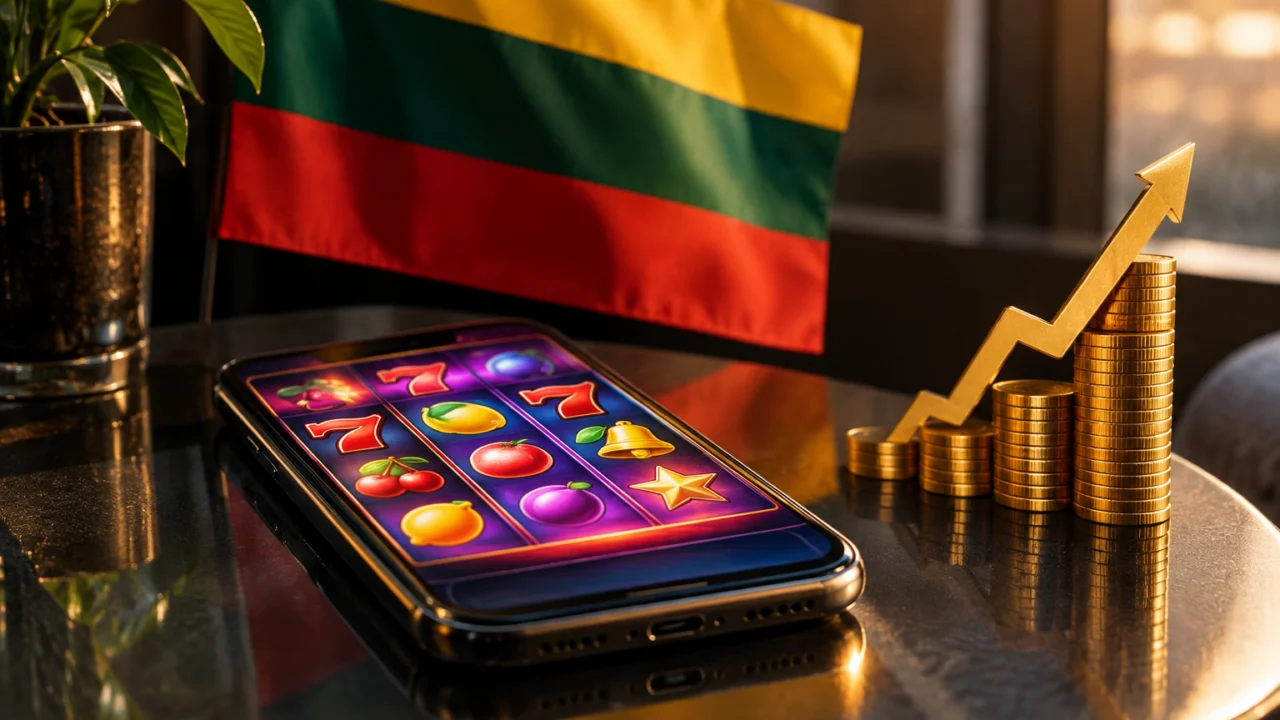
The Lithuania gambling market in 2026 shows online play holding 78% of revenue in the first nine months, according to the Gaming Supervisory Authority (LPT). Player losses of €229 million and online GGR of about €179 million measure different things, and this article separates them.
The mistake that inflates the online figure
It is easy to treat the €229 million in player losses as operator revenue, but that overstates what operators keep. Player losses are the money staked that was not paid back as winnings. Online GGR of about €179 million is the operator-side measure, so the two figures should never be read as interchangeable. Both come from LPT data for the first nine months of 2026.
Online holds 78% of the Lithuanian market
Online gambling produced 78% of all revenue in Lithuania in the first nine months of 2026, according to LPT. Online gross gaming revenue (GGR), the operator's income after player winnings are paid out, reached about €179 million, up roughly 22% year on year.
Player losses and GGR: two different measures
Player losses reached €229 million, or $251 million, up 14% on a year earlier. GGR, by contrast, is what the operator keeps after paying winnings. Use losses to gauge how much players spend, and GGR to gauge what operators earn.
Online versus land-based: the split holds steady
Online operators took about €179 million in GGR in the first nine months of 2026, up roughly 22%. Land-based venues brought in about €50 million, down 6.5%. The two channels moved in opposite directions, so the gap between them widened. According to LPT figures, online's share of the market has held steady since the first half of the year.
Slots, tables and physical machines
Online slots remain the engine of the Lithuanian online market. Category A slot games brought in €131.6 million, up 30% on the year. Online table games reached €17.7 million, a 24% rise. Category B remote games fell 67% to €608,700, a sharp drop that shows how much the mix has shifted toward slots and tables.
Physical machines are shrinking too. The number of machines fell to 3,736 from 3,914 a year earlier, and the number of venues dropped to 159 from 180.
Lottery sales and state tax receipts
Lottery sales reached €131.5 million, up 9% on the year. Taxes paid to the state totalled €74.19 million, up 15%. Of that sum, gambling operators paid €50.01 million.
Consolidation: 12 licensed operators and one major deal
By the end of September, 12 operators held Lithuanian gambling licences. In August, Fortuna Entertainment Group finalised its purchase of a majority stake in TOPsport. For new entrants, a smaller field of licence holders means a more concentrated market to assess.
Player cards: a Ministry of Finance proposal
The Ministry of Finance has proposed mandatory player cards from 1 January 2029, to control deposits and winnings. This is a proposal, not an adopted rule. So operators should track it as pending rather than plan around it as settled law.
FAQ
Why is the €229 million in player losses not the same as operator revenue?
Player losses are the money staked that was not paid back in winnings, while GGR is what the operator keeps after paying those winnings. The gap between €229 million and online GGR of about €179 million reflects that difference. LPT data for the first nine months of 2026 is the source for both figures.
When would player cards become mandatory in Lithuania?
The Ministry of Finance has proposed mandatory player cards from 1 January 2029. The cards would control deposits and winnings. It is a proposal, not an adopted rule, so it has not yet taken effect.
How many licensed gambling operators were active in Lithuania at the end of September 2026?
Twelve licensed operators held Lithuanian gambling licences at the end of September. In August, Fortuna Entertainment Group finalised its purchase of a majority stake in TOPsport. Both facts point to a more concentrated market.